Your shopping cart is empty!

Generative music has long been part of my work. It connects several fields that interest me: composition, mathematics, chance, chaos, improvisation, and the design of musical instruments.
By Gilles de Kaona
What do we write when every note is not determined in advance? What note do we play if it is not written in a score?
We can write a rule, use the memory of musical phrases, set thresholds or performance conditions, define relationships between several voices, and so on. We can decide what will remain recognizable, what will evolve slowly, and what may emerge during a performance. Composing then becomes a matter of choosing rules and conditions.
Chance can play a greater or lesser role in this approach. A series of values acquires musical meaning through the way it is interpreted. It may determine a pitch, a duration, a density, an accent, or the transition from one voice to another. The scale, meter, and memory of the system give each decision a function.
A completely stable process often reveals all its possibilities very quickly and ends up looping. At the other extreme, constant renewal makes it difficult to perceive relationships between events. I am looking for a performance space between these two states. Some figures must return to create a sense of memory, while others must change to keep the listening experience active. This tension between persistence and change lies at the heart of much of my work on generative instruments.
This way of composing has a long history. Imitation, inversion, retrograde, and augmentation were already central to counterpoint. Johann Sebastian Bach’s canons and fugues demonstrate how a precise rule can produce extraordinarily diverse music. A subject moves from one voice to another, changes register, encounters a countersubject, and passes through different sections. The rule organizes the musical discourse while leaving room for the composer’s decisions.
The musical composition games of the 18th century explored a different approach. Prewritten fragments were selected and assembled using tables or dice throws, as in Mozart’s musical dice game, which could be used to compose waltzes and minuets. The principle is playful, but it also has limitations: the procedure arranges fragments that have already been composed rather than creating its own material.
In the 20th century, the musical material itself became truly generative. Schoenberg’s organization of pitch, Markov chains, Xenakis’s stochastic methods, Cage’s chance operations, and Reich’s gradual processes moved this research towards new forms. Brian Eno later popularized the term “generative music” to describe systems capable of producing music that could continue renewing itself over long periods.
But it was Hiller and Isaacson, by programming the ILLIAC I and publishing the first major score produced through computation in 1956, who demonstrated the emergence of generative computer music.
Modular synthesis followed its own path. In the mid-1970s, Donald Buchla introduced the 266 Source of Uncertainty, which produces fluctuating, quantized, or stored random voltages. Eurorack has since multiplied the possibilities offered by shift registers, quantizers, and probabilistic sequencers.
With Skippy, I worked on generating and transforming grid-based and non-grid-based rhythms, using linear or logarithmic structures. The aim was to make temporal organizations accessible that would otherwise be tedious to program step by step.
Zazou extended this research to sequences, accompaniments, improvisation, and melody. Its four independent channels allow several behaviors to coexist. This independence immediately raises musical questions: how does each line retain its identity? When do several lines begin to form a coherent whole? How much repetition is needed for a phrase to become recognizable?
B.A.C.H. continues this research on the scale of polyphonic composition. Its name pays tribute to Johann Sebastian Bach, whose music accompanies me every day, as well as to the B–A–C–H motif. In German musical notation, these letters correspond to B-flat, A, C, and B-natural.
A random voltage knows nothing about what has just been played. A fugue does: it has a subject, an answer, and a current stage in its exposition, and that state persists over several measures. A cellular automaton follows a predictable evolution; an L-system retains its rewriting string, and so on. Moving generation to the scale of musical composition requires something to survive beyond the current measure. All the work on the B.A.C.H. firmware revolves around this persistence: each parameter modifies a state that will continue over time.
I have organized these approaches to composition into twelve musical languages, each with its own grammar.
FUGUE organizes a subject, answers, a countersubject, and episodes. CANON explores imitation and time displacement. PROBA uses Markov chains. TINTINNABULI combines a melodic voice with voices built from the notes of a chord. MINIMAL applies gradual transformations to short cells.
CELLULAR translates the evolution of a cellular automaton into music. TREE follows structures produced by L-systems. FRACTAL interprets self-similar mathematical sequences. MOTIF develops melodic and rhythmic cells. HYBRID distributes several engines among the four voices.
GROOVE and GROOVE MIX approach composition through rhythm.
These processes come from different periods and fields. Bringing them together in a single instrument required a common vocabulary that could be applied to every language, even though their grammars differ.
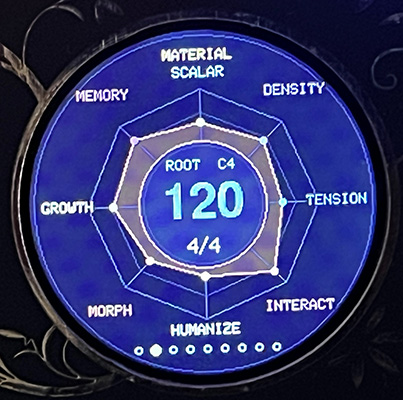
I chose eight concepts: material, memory, growth, transformation, density, tension, interaction, and interpretation.
MATERIAL selects the starting point. MEMORY determines how long an idea persists. GROWTH controls how a form develops. MORPH transforms what already exists. DENSITY determines how many events become audible. TENSION introduces deviations. INTERACTION organizes the relationships between voices. HUMANIZE adds performance gestures suited to the language being used.
The specific effect of these controls varies from one process to another. Growth may lengthen a section of a fugue, accelerate the generations of a cellular automaton, or increase the depth of a tree. Memory may preserve a subject, slow down a process, or maintain a rhythmic variation.
This continuity of vocabulary makes it possible to move from one language to another while retaining the same musical questions in the gestures of composition and performance.
Working with four voices also requires the organization of registers, consonances, entries, and melodic motion. Unlike Zazou, B.A.C.H.’s four voices depend on one another. The relationship between the lines becomes musical material in its own right. They may imitate one another, respond to one another, share a single figure, or follow independent processes.
A harmonic progression—a sequence or chord grid—can guide this work. It defines up to 64 chord positions and influences the structural notes produced by the engines.
A BREAK function provides an immediate way to intervene in the current performance. It can introduce silence, suspension, fragmentation, erosion, or temporary reconstruction. These functions give the musician the ability to shape the form at chosen moments.
B.A.C.H. is a generative instrument whose behavior remains perceptible: when a control is adjusted, the resulting change can be heard; when a setting remains unchanged, the system should retain its character, though not necessarily the same sequence of notes.
Some languages are deterministic and reconstruct the same structure from the same conditions. Others use probabilities. All of them maintain an internal state from one measure to the next. A subject may drift slowly. An automaton may stabilize a figure before losing it. A motif may retain its opening and cadence while its internal cells are reorganized. The music therefore has a past that influences its present.
I conceive these instruments as ways of observing and manipulating musical phenomena. They provide constraints precise enough to create an identity, yet open enough to accommodate the musician’s decisions.
This is the relationship I continue to explore with Skippy, Zazou, and now B.A.C.H.: writing the conditions for a piece of music, setting them in motion, and then intervening in their evolution.
Gilles de Kaona
 EN
EN  FR
FR